


AGM Batteries: Pros and Cons
An AGM (absorbed glass mat) battery is a sealed lead acid battery. Instead of letting liquid electrolyte slosh freely as a traditional flooded battery does, it holds the electrolyte in thin fibreglass mats pressed against the lead plates. That design makes AGM batteries spill-proof, maintenance-free, vibration-resistant and mountable in almost any position. In return, they cost more than flooded batteries and are less tolerant of overcharging and heat. AGM is the standard choice for UPS systems, alarm panels, mobility scooters, wheelchairs, emergency lighting and most small powersport equipment, and nearly every sealed lead acid battery BatteryClerk Canada sells is built this way.
In This Guide
- What Is an AGM Battery?
- How Does AGM Compare to Flooded Lead Acid?
- What Is the Difference Between AGM and Gel Batteries?
- What Are the Advantages of AGM Batteries?
- What Are the Disadvantages of AGM Batteries?
- How Do AGM Batteries Handle a Canadian Winter?
- How Long Do AGM Batteries Last?
- How Should You Charge an AGM Battery?
- Where Are AGM Batteries Used?
- Is an AGM Battery Right for You?
- Frequently Asked Questions
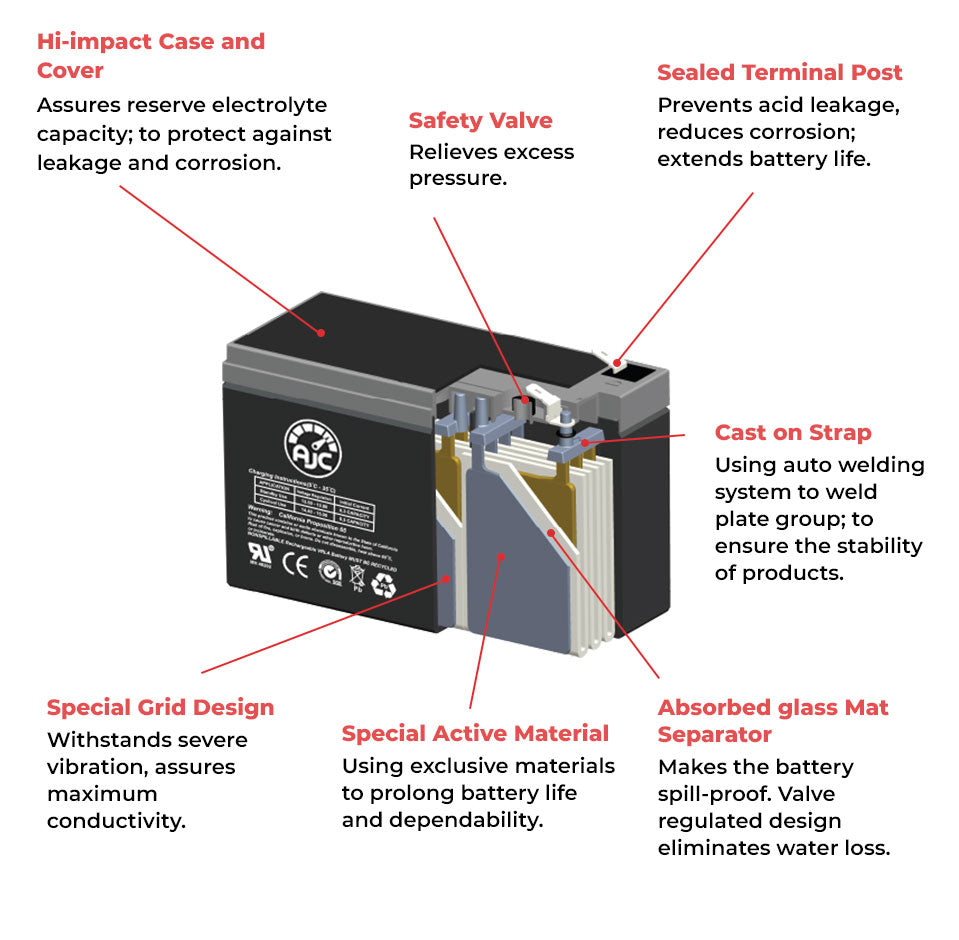
What Is an AGM Battery?
AGM stands for absorbed glass mat. Inside the battery, each lead plate is wrapped in a mat of very fine glass fibres. The sulphuric acid electrolyte soaks into those mats the way water soaks into a sponge, so the case holds no free liquid. The battery is sealed and fitted with small pressure relief valves, which is why AGM batteries are also called VRLA (valve regulated lead acid) batteries.
Being sealed also lets the battery recombine most of the oxygen and hydrogen produced during charging back into water. A flooded battery vents that gas and slowly loses water, so it has to be topped up. An AGM battery keeps its water and never needs refilling.
AGM technology was developed in the 1970s and came into wide use in the 1980s. Its first major users were military aircraft and other settings where a battery had to survive vibration, tilting and rough handling without leaking. Today AGM is one of the two types of sealed lead acid battery. The other is gel, covered below. For the full family tree, including wet cell and maintenance-free flooded batteries, see Types of Lead Acid Batteries.
You will sometimes see AGM batteries called "dry cell" batteries. That is a loose term: the electrolyte is still liquid, it is just fully absorbed into the mats.
How Does AGM Compare to Flooded Lead Acid?
A flooded (wet cell) battery has its plates submerged in liquid electrolyte, usually with removable caps for adding water. The table below compares the two on the points that matter most when you are choosing a replacement.
| Feature | AGM (sealed lead acid) | Flooded lead acid |
|---|---|---|
| Spills if damaged or tipped | No | Yes |
| Mounting position | Upright, on its side or on its end (avoid upside down) | Upright only |
| Routine maintenance | None. Sealed, never needs water | Check and top up water regularly |
| Gassing during normal charging | Very low | Significant. Needs ventilation |
| Vibration and shock resistance | High | Moderate |
| Self-discharge in storage | Low, typically about 3% per month at room temperature | Higher, needs more frequent recharging in storage |
| Sensitivity to overcharging | High. Needs the correct charge voltage | More forgiving. Lost water can be replaced |
| Purchase price | Higher | Lower |
| Shipping | Non-spillable designs face fewer dangerous goods restrictions | Regulated as a spillable battery |
In short, flooded batteries cost less up front and put up with rough charging better, but they need upkeep, ventilation and an upright mounting spot. AGM batteries cost more, but you can put them almost anywhere and leave them alone. That is why sealed equipment such as UPS units, alarm panels and mobility scooters is designed around AGM.
What Is the Difference Between AGM and Gel Batteries?
Both are sealed lead acid batteries, and both are spill-proof and maintenance-free. What differs is how the electrolyte is held: AGM absorbs it into glass mats, while a gel battery mixes it with silica into a thick paste.
- AGM has lower internal resistance, so it handles high bursts of current well and recharges faster. It is also the more common and less expensive of the two.
- Gel copes somewhat better with repeated deep discharges and high ambient heat. It delivers less peak current, though, and needs a lower charging voltage, so charging a gel battery on an AGM profile can damage it.
Because the charging profiles differ, replace gel with gel and AGM with AGM unless the equipment manufacturer says otherwise. Gel batteries are clearly labelled "GEL." Lithium is a different chemistry altogether, and we compare it with sealed lead acid in SLA Batteries vs Lithium Batteries.
What Are the Advantages of AGM Batteries?
- Spill-proof. With no free liquid inside, a cracked AGM battery will not pour acid, so it is safer to handle, install and transport.
- Mounts in almost any orientation. AGM batteries can sit upright, on their side or on their end, which lets equipment designers fit them into tight compartments. Most manufacturers advise against mounting them fully upside down.
- Maintenance-free. There is no water to check or add and no acid to measure. Install it and leave it alone.
- Strong vibration and shock resistance. The tightly packed mats hold the plates firmly in place. That is why aircraft adopted AGM, and why it is now standard in motorcycles, ATVs, snowmobiles, personal watercraft and other equipment that rattles and bounces.
- Very little gassing. Most of the gas produced during charging recombines inside the battery, so AGM batteries can go in enclosed cabinets and indoor equipment where a flooded battery would need ventilation.
- Low self-discharge. A healthy AGM battery loses roughly 3% of its charge per month at room temperature, so seasonal and standby equipment holds its charge far longer between top-ups.
- Good cold-weather performance. AGM batteries deliver power well in the cold, and a fully charged one resists freezing far below anything a Canadian winter produces. A discharged one is a different story. See the winter section below.
- High current on demand. Low internal resistance lets AGM batteries supply strong bursts of current. That suits engine starting, and UPS systems that must carry a full load the instant the power fails.
- Simpler shipping. Batteries that meet non-spillable requirements face fewer dangerous goods shipping restrictions than spillable flooded batteries, in Canada and the U.S. alike.
What Are the Disadvantages of AGM Batteries?
- Higher purchase price. The glass mat separators and sealed construction cost more to manufacture, so an AGM battery typically costs more than a flooded battery of the same size.
- Sensitive to overcharging. An AGM battery is sealed, so any water it loses to overcharging is gone for good. Sustained high voltage dries the mats out and shortens the battery's life, which is why you need a charger with the correct AGM or SLA profile.
- Sensitive to heat. Heat shortens the life of any sealed lead acid battery more than anything else. A common rule of thumb is that service life roughly halves for every 8 to 10°C (15 to 18°F) the battery runs above about 25°C (77°F). A UPS in a hot closet will need new batteries much sooner than one in a cool room.
- Shorter life under repeated deep discharge. Draining an AGM battery completely over and over wears it out far faster than shallow discharges do. Equipment that routinely runs the battery flat will go through batteries quickly.
- Needs prompt recharging. An AGM battery left partly discharged for long periods develops sulphation, which permanently reduces capacity. See SLA Battery Sulfation.
- Heavy compared with lithium. AGM weighs about the same as a flooded battery of similar capacity, but much more than a lithium battery with the same usable energy.
- Cannot be tested with a hydrometer. Because the case is sealed, you cannot measure specific gravity the way you can with a flooded battery. Use a voltmeter or a conductance tester instead. See How to Test an SLA Battery.
How Do AGM Batteries Handle a Canadian Winter?
An AGM battery copes with cold well, as long as it stays charged. What freezes a battery is how far it has been discharged, not the thermometer alone. As a lead acid battery discharges, its electrolyte becomes closer to plain water, and its freezing point climbs with it. According to Battery University, a fully charged lead acid battery freezes at about -55°C, while a fully discharged one can freeze at around -15°C. That is an ordinary January night in an unheated garage, shed or cottage.
Freezing does permanent damage. A sealed lead acid battery that has frozen loses capacity and may deliver only a few more cycles before it fails, even if it seems to recover once it thaws.
To get AGM batteries through the winter:
- Store them fully charged. Charge stored batteries before the cold sets in, and top them up every month or two. A float or maintenance charger with an AGM setting makes this automatic.
- Bring seasonal batteries indoors if you can. Batteries from motorcycles, personal watercraft, ride-on toys and summer equipment last longer stored somewhere cool and dry but above freezing.
- Charge gently in the cold. Lead acid batteries can be charged down to about -20°C, but only at a reduced rate. If a battery may already be frozen, let it warm to room temperature before you charge it.
- Watch the terminals. Road salt and slush speed up corrosion on snowmobile, ATV and scooter terminals, and a corroded terminal can look exactly like a dead battery. Clean terminals and a light coat of terminal protector prevent a lot of false "dead battery" calls.
Cold also temporarily reduces how much capacity a battery can deliver, so a scooter or snowmobile will not go as far on a frigid day. That loss comes back as the battery warms up. Lasting damage only happens when a discharged battery actually freezes.
How Long Do AGM Batteries Last?
In standby use, where the battery sits on a float charge waiting for a power outage, a standard AGM battery typically lasts 3 to 5 years. Long-life series built for telecom and data centre use are rated for 10 years or more. That is the life to expect from UPS systems, alarm panels and emergency lighting kept at normal room temperature.
In cyclic use, where the battery is drained and recharged regularly, life is counted in charge cycles, and depth of discharge matters most. An AGM battery that is regularly drained only partway will deliver many more cycles than one that is run flat every time. Mobility scooters, wheelchairs and ride-on toys fall into this category.
Four things shorten AGM life more than anything else:
- Heat. Keep batteries as close to room temperature as the equipment allows.
- Deep discharges. Recharge before the battery is fully drained whenever you can.
- Wrong charging. Overcharging dries the battery out, and chronic undercharging sulphates it.
- Freezing while discharged. A common cause of early failure in Canadian seasonal equipment. See winter care above.
For day-to-day habits that extend battery life, see SLA Battery Care.
How Should You Charge an AGM Battery?
Use a charger designed for AGM or sealed lead acid batteries. A good AGM charger works in stages. The bulk stage delivers most of the charge, the absorption stage holds a set voltage until the battery is nearly full, and the float stage keeps it topped up without overcharging.
For a typical 12V AGM battery at room temperature, published charging values fall roughly in these ranges:
- Cyclic charging (absorption): about 14.4 to 14.9 volts
- Standby or float charging: about 13.5 to 13.8 volts
Always check the label on your battery, since most AGM batteries print their exact cycle and standby voltages and their maximum initial charging current right on the case. An older charger built for flooded batteries, with no AGM setting, can overcharge an AGM battery, and a gel setting can undercharge one. Some smart chargers also adjust voltage for temperature, which helps batteries kept in unheated spaces. For step-by-step guidance, see Charging SLA Batteries.
Where Are AGM Batteries Used?
AGM is the default battery for sealed equipment that has to work reliably without maintenance. Common uses include:
- UPS and battery backup systems: UPS batteries for computers, servers and network equipment
- Alarm and security panels: alarm batteries, usually small 12V 4Ah to 7Ah units
- Emergency and exit lighting: emergency light batteries
- Mobility equipment: mobility scooter batteries and wheelchair batteries
- Medical devices: medical equipment batteries
- Snowmobiles: snowmobile batteries, where vibration resistance and cold-weather starting both matter
- Motorcycles and powersports: motorcycle batteries and powersports batteries for ATVs, side-by-sides and personal watercraft
- Kids' ride-on toys: ride-on toy batteries
- Fish finders and small marine electronics: fish finder batteries, including for ice fishing
Many of these systems run two or more 12V AGM batteries wired in series through a single charger. A series pack can only perform as well as its weakest battery, so when one battery fails, replace the whole set with matching batteries of the same capacity and age. Pairing a new battery with old ones shortens the life of the new one.
AGM batteries are also common in modern cars, especially vehicles with automatic start-stop systems, which put heavier demands on the starting battery. BatteryClerk Canada does not carry automotive starting batteries. For a car, check with your dealer or an auto parts retailer, and match the battery type your vehicle came with.
Is an AGM Battery Right for You?
An AGM battery is the better choice when:
- the battery sits inside a sealed device or cabinet, or indoors
- it might be tipped, mounted on its side or exposed to vibration
- it spends long periods on standby or in seasonal storage
- nobody will be checking water levels
- the original battery was AGM, which covers almost all UPS, alarm and mobility equipment
A flooded battery may make more sense when cost is the main concern, the battery sits upright in a ventilated space and someone will maintain it. If your equipment was designed for lithium, or you are weighing a switch to lithium, read our SLA vs lithium comparison first, because the charger and the equipment both have to support the change.
Frequently Asked Questions
What does AGM stand for on a battery?
AGM stands for absorbed glass mat. It describes how the battery holds its electrolyte: soaked into thin fibreglass mats between the lead plates instead of as free liquid. AGM batteries are a type of sealed lead acid (SLA) battery, also called valve regulated lead acid (VRLA).
Is an AGM battery the same as a sealed lead acid battery?
AGM is one of the two types of sealed lead acid battery. The other is gel. Most sealed lead acid batteries sold for UPS systems, alarms, mobility scooters and powersports equipment are AGM, so the two terms are often used interchangeably.
How do I know if my battery is AGM?
Check the label for "AGM," "VRLA," "sealed lead acid" or "non-spillable." An AGM battery has no removable caps for adding water. Gel batteries are labelled "GEL." If the label is worn off, the equipment manual or the original part number will identify the battery type.
Can I use a regular battery charger on an AGM battery?
Only if the charger has an AGM or sealed lead acid setting, or is rated for AGM batteries. Older chargers built for flooded batteries can push too much voltage into an AGM battery, drying it out and shortening its life. A multi-stage smart charger with an AGM profile is the safest choice.
Can an AGM battery be mounted on its side?
Yes. Because the electrolyte is fully absorbed into the glass mats, an AGM battery can be mounted upright, on its side or on its end without leaking. Most manufacturers recommend against mounting it fully upside down.
Can AGM batteries freeze?
Yes, if they are discharged. A fully charged lead acid battery does not freeze until about -55°C, but a fully discharged one can freeze at around -15°C, and freezing permanently damages it. Keep AGM batteries charged through the winter, and top up stored batteries every month or two.
Can I leave an AGM battery in an unheated garage over the winter?
You can if it stays fully charged, ideally on a maintenance charger with an AGM setting. The risk is a battery that slowly discharges over the winter until it freezes. If you cannot keep it on a charger, store it indoors somewhere cool and dry, and charge it before putting it back in service.
Are AGM batteries worth the extra cost?
For most sealed equipment, yes. AGM batteries need no maintenance, will not spill, tolerate vibration and hold their charge in storage. In UPS systems, alarms, mobility scooters and powersports equipment, AGM is usually the only type that fits and works safely. A flooded battery only saves money where it can sit upright, be ventilated and be maintained.
Should I replace all the batteries in a pack at the same time?
Yes, if the batteries are wired together in series, as they are in most mobility scooters, wheelchairs and larger UPS units. A series pack only performs as well as its weakest battery, so a new battery paired with worn ones will be dragged down and fail early. Replace them as a matched set.
Find Your Replacement AGM Battery
Search by your equipment's brand and model, or browse BatteryClerk Canada's full range of sealed lead acid batteries. Popular categories include UPS batteries, alarm batteries, mobility scooter batteries and snowmobile batteries. When your old battery reaches the end of its life, see Battery Recycling for how to dispose of it safely.